
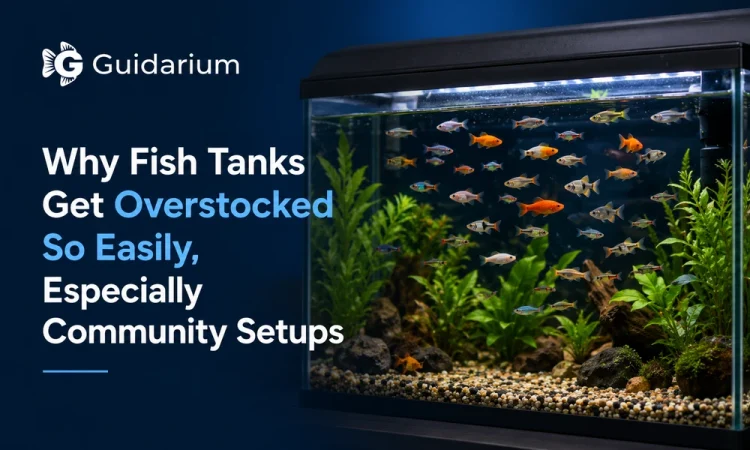
Compared with dogs, cats, or even small mammals, fish can look deceptively low-maintenance from the outside. They are quiet, enclosed in one place, and easy to buy in small numbers. That makes fishkeeping attractive to many first-time pet owners, but it also creates one of the hobby’s most common mistakes: adding too many fish to one tank without realizing it.
This happens especially often in a community tank, meaning a mixed-species aquarium where several compatible fish share the same space. In many cases, the tank does not look crowded in the beginning. The fish are small, the water still looks clear, and nothing seems obviously wrong. That early calm is exactly why so many setups drift past a sensible limit.
Community aquariums rarely become overstocked because somebody set out to make bad decisions. More often, the problem grows out of reasonable choices made one at a time. A hobbyist adds a few schooling fish because the upper level looks empty. Then a pair of bottom dwellers goes in because the gravel seems unused. Later, a centerpiece fish is added because the tank still looks sparse from the front glass. Each purchase feels minor on its own, but the total load keeps rising.
What makes this harder is that stocking is not just about counting bodies or gallons. It is about adult size, activity level, territory, group size, filtration, maintenance habits, tank dimensions, and how species interact over time. A tank can look balanced for weeks or months while moving toward chronic stress, unstable water quality, and long-term compatibility problems.
If community tanks get overstocked so often, it is not because the issue is rare. It is because the warning signs usually appear later than the decision mistakes that caused them.
Overstocking Usually Starts Before the Tank Looks Full
The visual impression of a tank is a poor way to judge whether it is properly stocked. Fish do not occupy space the way furniture does. They use territory, swimming lanes, rest areas, cover, and access to food. A setup that appears open to the human eye may already be too demanding biologically and behaviorally, even if it still looks neat on a living-room stand.
Juvenile fish create false confidence
Many freshwater fish sold in shops are juveniles or young subadults. That is practical for retailers, but it also makes stocking errors more likely. A fish that looks modest at purchase may double in length, bulk up noticeably, or become much more assertive as it matures. The problem is not only final size. Growth changes the way a species uses space.
This is why a tank can feel comfortably stocked on day one and much tighter three or four months later. The aquarist did not necessarily add too many fish all at once. The original plan was simply built around the current appearance of young fish instead of the real demands of adult fish.
Empty water is not the same as spare capacity
Another common trap is assuming that any visibly open space equals room for more fish. A community tank can have unused-looking space near the surface or center and still be near its practical limit. Fish that stay low in the tank still contribute waste. Midwater schooling fish still need turning room and stable group dynamics. Surface fish still depend on oxygen exchange and calm feeding zones.
In other words, capacity is not a matter of filling every layer like shelves in a cabinet. The fact that one zone looks quiet does not mean the tank has unused biological or behavioral margin.
Good early behavior can be misleading
New fish often seem peaceful in the short term because they are settling in, still small, or not yet competing as heavily for resources. A tank that looks harmonious in the first few weeks may only be in a grace period. Once fish establish territories, mature, or begin breeding behavior, the same stocking level can feel very different.
That delayed feedback is one reason hobbyists trust a setup that later proves too busy. The tank did not lie exactly. It just had not revealed the full cost of the plan yet.
The Most Common Stocking Mistakes in Community Aquariums
Most overstocked tanks are the result of familiar planning mistakes rather than one dramatic error. These are the ones that show up again and again.
Relying on simple rules instead of species needs
The old habit of reducing stocking to a quick formula remains one of the biggest reasons community tanks go off track. Simple rules feel useful because they are easy to remember, but they flatten important differences between fish. A slim, active schooling species is not equivalent to a deeper-bodied territorial fish of the same length. A peaceful bottom scavenger does not place the same demands on space as a cichlid with a claim to half the tank.
Rules that sound tidy often ignore the things that matter most: body mass, waste production, aggression, activity, oxygen demand, and social structure. They can provide false reassurance right when a hobbyist needs a more detailed picture.
Ignoring group size requirements
Community stocking problems are not always caused by keeping too many fish. Sometimes they begin with keeping the wrong number of the right fish. Schooling species, which feel safer and behave better in groups, are often purchased in undersized numbers. The hobbyist then adds more fish later to fix the imbalance, but by that point the tank may already be stretched.
A proper stocking plan accounts for minimum group size from the start. If a species really needs six, eight, or more individuals to behave normally, that requirement should be treated as part of the base cost of keeping that fish at all.
Treating filtration as extra room
Strong filtration helps, but it does not erase the limits of the aquarium. A larger filter can improve mechanical and biological processing, yet it does not change how much swimming room fish have, how much territory they contest, or how much stress comes from crowding.
This is one of the more persistent misconceptions in community fishkeeping. A heavily filtered tank may stay clear and test acceptably for a while, which makes it tempting to believe the setup can comfortably absorb more fish. But good equipment can mask weak stocking decisions. It can delay visible problems without solving the underlying space issue.
Adding fish to “use” every zone
Many hobbyists build a stocking list with the idea that every level of the tank should be occupied: something for the top, something for the middle, something for the bottom, and maybe a cleanup crew besides. That approach sounds balanced, but it often turns the aquarium into a checklist instead of a living system.
Not every successful tank needs fish at every level. Sometimes the better choice is to leave more open space, keep one larger school instead of several smaller groups, or skip a bottom species if the tank footprint is already limited. Filling every niche is satisfying on paper, but it often pushes a tank from comfortably stocked to busy and brittle.
Underestimating the “small additions”
Overstocking usually happens through accumulation. A few extra tetras do not seem like much. A pair of dwarf corys feels minor. One algae eater sounds practical. Then a replacement fish is added after a loss, followed by a new species that caught the eye during a routine shop visit.
The danger is not the single purchase. The danger is losing track of the cumulative load. Community tanks reward restraint, and that restraint gets harder when additions are spread over months instead of made in one obvious jump.
Why an Overstocked Tank Can Seem Fine for a While
One reason this problem frustrates newer hobbyists is that a tank can function above a comfortable stocking level for quite a long time before consequences become obvious.
The biofilter can absorb the first phase
An established filter system, including the beneficial bacteria that break down fish waste, often softens the early impact of extra fish. If the tank is mature, planted, and maintained consistently, it may cope better than expected in the short term. Water tests may not immediately show a crisis, and fish may continue eating and swimming normally. That creates confidence.
But coping is not the same as having margin. A tank running near its limit has less room for routine problems: missed maintenance, a dead fish hidden behind decor, warmer weather, a feeding mistake, or one aggressive individual disrupting the rest of the community.
Maintenance can delay consequences
Frequent water changes can keep an overloaded system presentable for longer than it deserves. The aquarist may feel that the routine is working, and in a narrow sense it is. The issue is that the tank becomes dependent on unusually strict upkeep just to stay stable. If the system only works when maintenance is perfect, then the stocking level is probably doing too much of the decision-making.
That matters because fishkeeping should have some resilience built into it. A healthy community tank should not feel one missed weekend away from trouble.
Clear water is not proof of a healthy stocking level
This is another trap worth calling out directly. Water clarity is not a reliable measure of whether a tank is sensibly stocked. Clear water can exist alongside chronic crowding, social stress, restricted swimming space, or long-term nitrate pressure. Fish can be “alive and visible” while still being kept in a setup that asks too much of them.
A good stocking plan is not just about avoiding disaster. It is about giving fish room to behave normally over time.
How to Judge Stocking More Realistically
If quick formulas and visual guesses are unreliable, what should hobbyists do instead? The answer is not complicated, but it does require a more complete way of thinking. This is also the point where fishkeeping starts to look a lot like responsible pet ownership in general: the right question is not “Can I fit one more?” but “Can I care for this animal well over time?”
Start with adult size, behavior, and social needs
Every stocking decision should begin with the adult fish, not the shop fish. Look at expected length, body shape, energy level, temperament, and whether the species wants company or space. A peaceful fish that needs a proper group may demand more real capacity than a larger but more sedentary species. A territorial fish may claim far more practical room than its dimensions suggest.
This is also where many community tanks quietly go wrong. The list might be composed of individually reasonable species, but the mix does not leave enough room for them all to act like themselves at the same time.
Think about footprint, not just gallon number
Aquarists often talk about tank size as a single number, but fish experience the enclosure as shape and usable area, not as an abstract volume. A long tank and a tall tank with similar gallons can stock very differently because swimming length, floor space, and territory layout are not the same.
That is especially important for bottom fish, active schooling species, and any fish that needs horizontal movement more than vertical depth. When hobbyists are comparing layouts or trying to understand how different dimensions affect capacity, a reference for common aquarium tank sizes can be more helpful than thinking in gallons alone.
Leave deliberate empty capacity
A good community tank should not be planned to the edge of what seems technically possible. It should include a buffer. Fish grow. Group numbers change. Personality differences show up. Sometimes a species that is usually peaceful becomes pushy in a particular mix. Sometimes a “temporary” juvenile ends up staying longer than expected.
Leaving extra room is not wasted potential. It is what makes a tank calmer, more stable, and easier to manage. It also gives the aquarist options if one species needs a larger group than expected or one fish becomes dominant and requires rearrangement.
Check the full plan before buying more fish
One of the simplest ways to avoid overstocking is to stop judging additions in isolation. Instead of asking whether one more fish seems harmless, evaluate the whole tank as it stands and the whole tank as it would look after the purchase. Running the numbers and species mix through Guidarium’s aquarium stocking calculator is often a better reality check than relying on the impression that the tank still looks open.
The key value of a tool like that is not that it replaces judgment. It forces a hobbyist to make the plan visible. Adult sizes, species count, and the total combination become harder to ignore once they are laid out together.
A Better Way to Build a Community Tank
The easiest overstocking problems to solve are the ones prevented before the shopping trip.
Build around a core plan, not impulse additions
A strong community tank usually has a clear structure: perhaps one main school, one compatible bottom group, and maybe a centerpiece fish if the tank size and temperament allow it. That kind of plan is easier to manage than a collection of species added because they seemed individually appealing.
Impulse additions are a major source of overstocking because they are made without rebalancing the full setup. Every new fish should be considered in relation to what is already there, not only on its own merits.
Favor fewer species in better numbers
This is one of the most useful mindset shifts for community aquariums. Many tanks improve when the owner keeps fewer species but keeps them properly. A larger, settled school of one species often looks better and behaves more naturally than several undersized groups competing for the same space.
This approach also makes stocking easier to manage. Fewer moving parts means fewer compatibility variables, less territorial overlap, and a clearer sense of whether the tank still has room.
Reassess after every addition
Community stocking should be treated as a process, not a one-time list. After new fish are added, the aquarist should watch how feeding changes, whether fish are displaced from preferred areas, whether maintenance demands increase, and whether shy fish become more withdrawn.
Those observations matter because overstocking is often first visible in behavior, not in test results. A tank can remain chemically acceptable while still becoming socially crowded.
What to Do If Your Tank Is Already Overstocked
Discovering that a tank is overstocked does not mean the setup is ruined. It does mean the next decisions should be practical rather than sentimental. For general pet readers, the closest comparison is realizing you brought home more animals than your space and routine can support comfortably. The humane answer is to adjust the setup, not to hope the problem sorts itself out.
Pause all new additions
The first step is simple: stop adding fish. Do not try to “balance” the tank with another species, and do not assume one more cleanup fish will improve the situation. Overstocking problems rarely get fixed by purchasing something else.
Identify the real pressure points
Look at the tank honestly. Is the main issue adult size? Too many species? Poor group numbers? Bottom-level crowding? Territorial conflict? Weak horizontal swimming space? The right solution depends on the actual bottleneck. In some tanks, removing one incompatible species solves more than removing several small peaceful fish.
Rehome, reduce, or upgrade with a clear reason
If the tank is beyond what sensible maintenance can support, then some combination of rehoming fish, reducing the species list, or moving to a larger aquarium is the practical answer. The goal should not be to preserve every original purchase at all costs. The goal should be to create a setup that remains stable and humane over time.
Upgrading can help, but only if the new tank truly solves the limiting factor. A slightly larger gallon number does not automatically fix a footprint problem or a compatibility problem. The move should match the reason the old tank felt crowded.
Do not confuse emergency management with good stocking
Extra water changes, heavier filtration, and more intense maintenance may be necessary while fixing an overstocked setup. They are useful tools. They are not proof that the stocking level was sound. Good emergency management is still just management. The better endpoint is a tank that does not need heroic effort to stay comfortable.
FAQ
How do I know if my community tank is overstocked?
The clearest signs are often indirect: rising maintenance demand, fish being pushed out of preferred areas, frequent low-level chasing, shrinking open swimming lanes, and a setup that only feels stable when upkeep is unusually strict. Visible crowding is a late sign, not an early one.
Is overstocking only about water quality?
No. Water quality matters, but overstocking is also about behavior, territory, stress, oxygen demand, and whether fish can use the tank naturally. A tank can test acceptably and still be too crowded for long-term success.
Should every community tank have fish in the top, middle, and bottom?
Not necessarily. That idea sounds tidy, but it can push hobbyists to overfill a tank. Some of the best community aquariums leave more unused-looking space and focus on a smaller number of species that fit the tank well.
Final Thought
Most community tanks do not become overstocked because the owner is careless. They become overstocked because aquarium decisions are usually made incrementally, while the consequences show up gradually. Fish are bought young, tanks are judged by appearance, simple rules replace species research, and each extra addition feels too small to matter.
That is why the best protection against overstocking is not a single rule. It is a better process: plan around adult fish, prioritize behavior and tank dimensions, keep a margin of empty capacity, and reevaluate the whole community every time the stocking list changes. A tank that looks slightly underfilled on paper often turns out to be the one that works best in real life.